Two tools to change a system
The Eight Principles of Artisan Economics and the HFI Taproot Model of Systems Change™ — the frameworks at the heart of the book, and the foundation of the courses and workshops to come.
The Eight Principles of Artisan Economics
Distilled from two decades alongside the world’s makers, these eight principles describe how the artisan economy works — and how any organization, community, or life can work better. Each maps onto a layer of the HFI Taproot Model of Systems Change™ below: purpose, creativity, and dignity at the roots; resistance and community in the trunk; value and sustainability in the branches; shared prosperity in the canopy.
Work driven by heritage, family, and community — not profit alone. When purpose leads, work becomes meaningful, sustainable, and interconnected.
Not just in the product — in solving problems, sustaining resources, and staying relevant. Innovation and tradition can live hand in hand.
The maker is the meaning. When you value what’s made, you must value who made it — and dignified work sustains workers, supply chains, and trust.
Craft asserts identity in the face of erasure and challenges injustice through creation instead of destruction. It preserves what systems try to wipe out.
Collaboration over competition; shared well-being over individual gain. Cooperatives and kinship are infrastructure, not afterthoughts.
Quality over quantity — and makers brought out of the shadows. We don’t just ask what something costs. We ask what it carries.
Not a fix after harm but the starting point: local, low-impact, place-based. Artisans make what the earth allows, not what the market demands.
Prosperity designed to circulate — through households, communities, and ecosystems. Civic wealth: income, yes, but also health, well-being, and justice.
The HFI Taproot Model of Systems Change™
Radical change is radicle change. Both words share the Latin radix — root. When a seed germinates, the radicle presses down into the soil before any green appears above ground. To be radical, at its source, is simply to get to the root of things.
The model grew out of Trade+Impact’s 2020 Handmade Futures Summit — a lifeline for artisans cut off from shuttered global markets during the pandemic — and three years of a global working group, from artisan makers to corporate executives, asking what the sector would look like at its best.
It maps a system as a living tree inside a wider forest. At the roots: values and mental models — the eleven taproot values the HFI group named, from equity to well-being. The trunk is where values meet relationships and power. The branches are the visible structures — policies, platforms, prices. The canopy is outcomes: whether people are actually thriving. And the forest is the context every system grows within.
Each layer maps to a kind of change — structural in the branches and canopy, relational in the trunk, transformational at the roots. Each is harder to achieve as you go deeper, and more durable once you do.
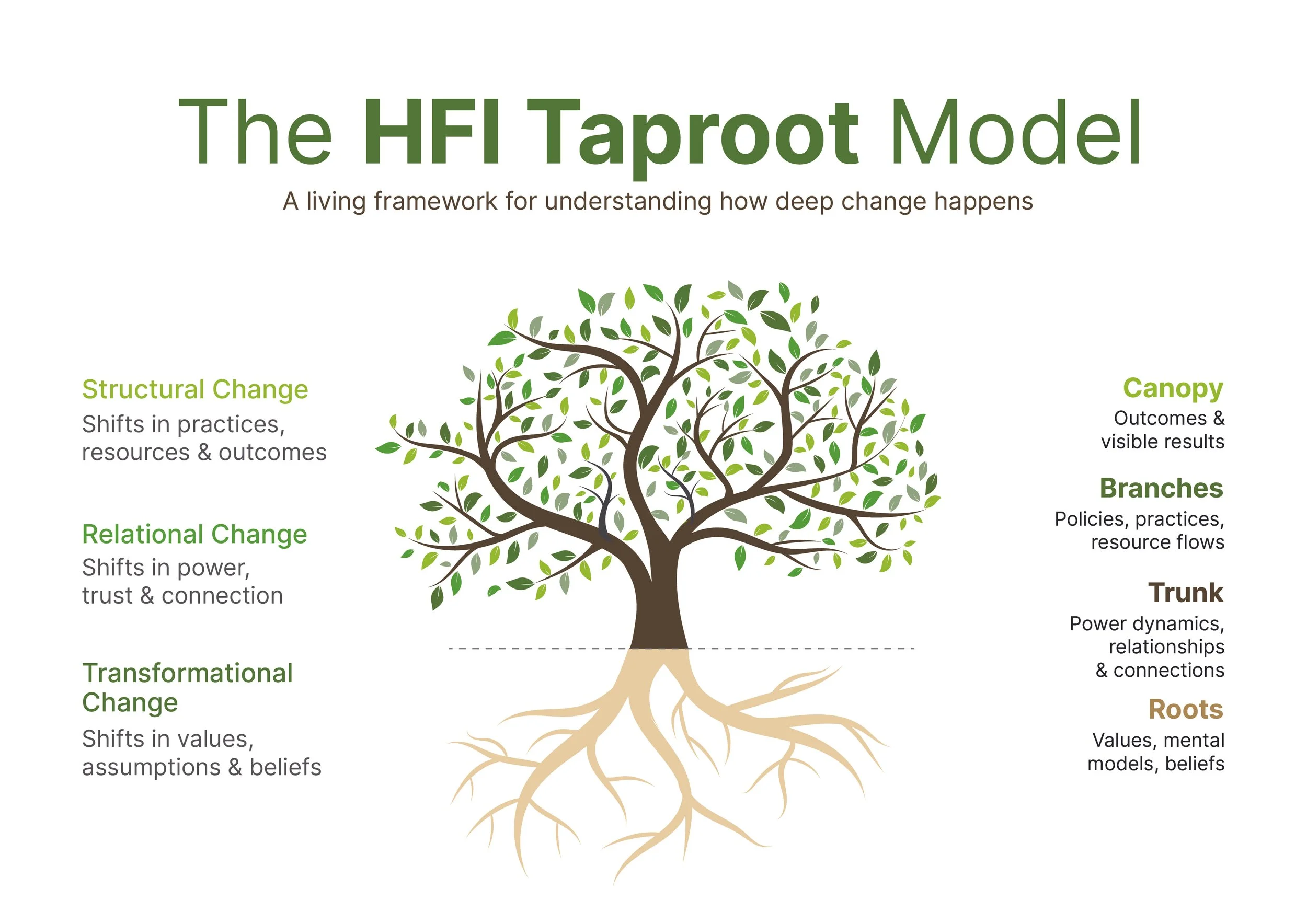
HFI Taproot Model of Systems Change™ · Trade+Impact Handmade Futures Initiative
Put Them to Work
Courses & workshops
Online Course
The 8 Principles of Artisan Economics
An engaging course for changemakers, students, and conscious businesses: the eight principles, the HFI Taproot Model of Systems Change™, and how to bring them into your own organization and life.
In development — join the list to hear first
Workshops & Training
HFI Taproot Model of Systems Change™
Facilitated in-person and virtual workshops for teams, classrooms, and communities ready to grow change from the roots — from a half-day introduction to multi-session programs.
Online course — and eventually a train-the-trainers program — in development
Researcher or development practitioner? My third model — the Ripple Effect of Artisan Entrepreneurship, mapping how craft income transforms lives from the woman to the world — lives with the scholarship. The research →
Artisan Economics, twice a month
Stories of the world’s makers — essays and podcast episodes, twice a month. Join the list and be first to read the opening chapter.
Signups go straight to the Artisan Economics list on Substack — one list, no copying, unsubscribe anytime.